
Last week, our data analysts Philipp and Denise attended the Remote Sensing and Copernicus Forum at ESA in Darmstadt.
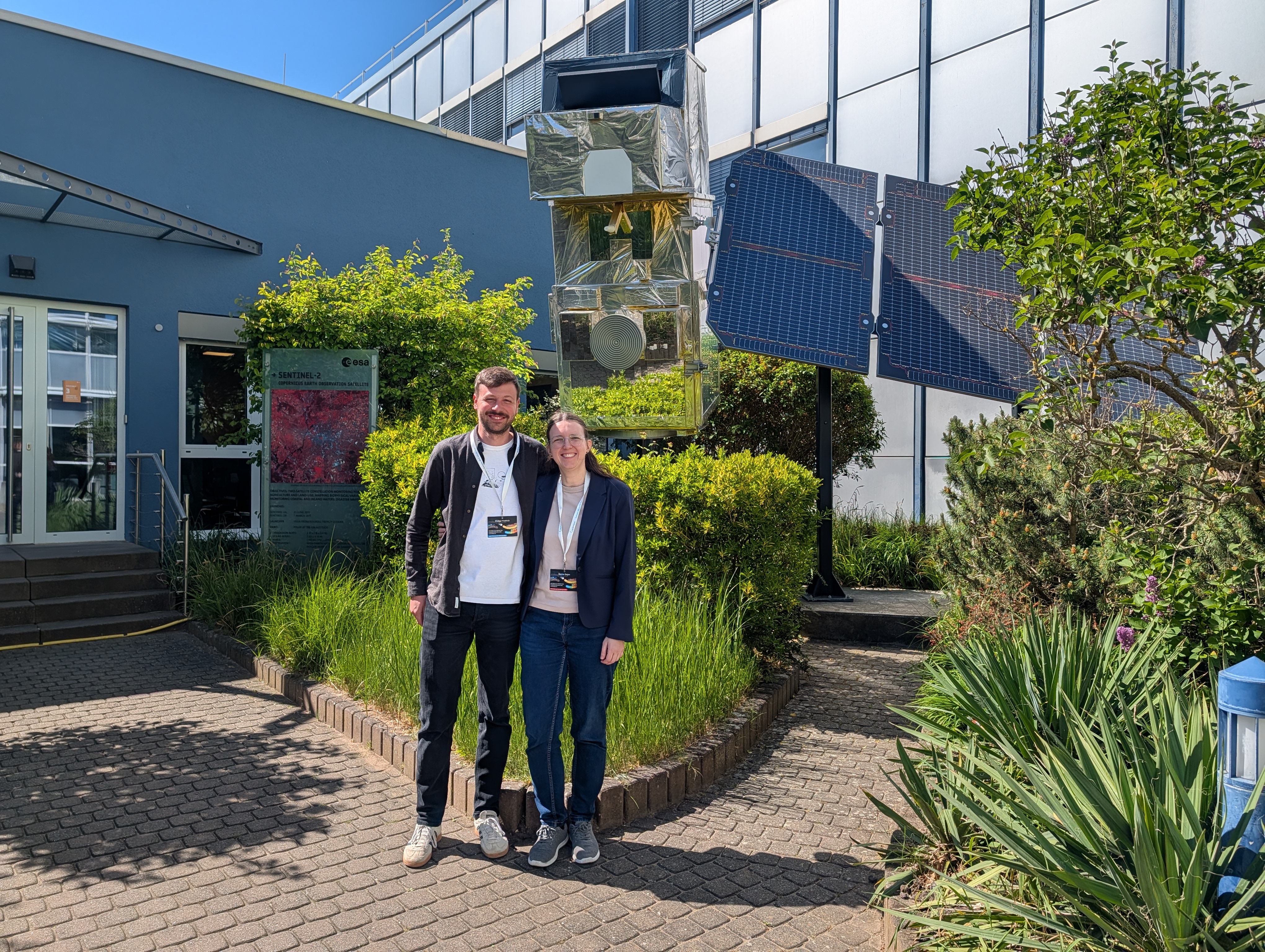
It was a special venue where we could see firsthand the work behind the data we use every day: At ESOC, satellites are monitored, orbits are calculated, and data is corrected. We were also fascinated by the control rooms and the replicas of the Copernicus satellites (we even posed in front of Sentinel-2, see photo;)).
The Copernicus program is being expanded, and several commercial providers of satellite data were also on site. And the data is in high demand! This is evident, for example, in the fact that representatives from five federal ministries were present—ministries that use remote sensing data in the fields of transportation, the environment, agriculture, domestic policy, and climate protection.
This makes companies like ours all the more important, as we make the value of this data accessible even to non-remote-sensing-experts. For example, with our project for detecting sugar beet diseases based on hyperspectral data, which we presented in the poster session (see project description).
Satellite data is also being used more and more at the local level: for example, for the tree inventory in Wuppertal or the mapping of drainage ditches in Hamburg.
For us, the forum offered a good mix of technical presentations and personal exchanges. Many thanks to the organizers — the Federal Ministry of Research, Technology and Space and the German Space Agency at DLR — for making this valuable platform possible!