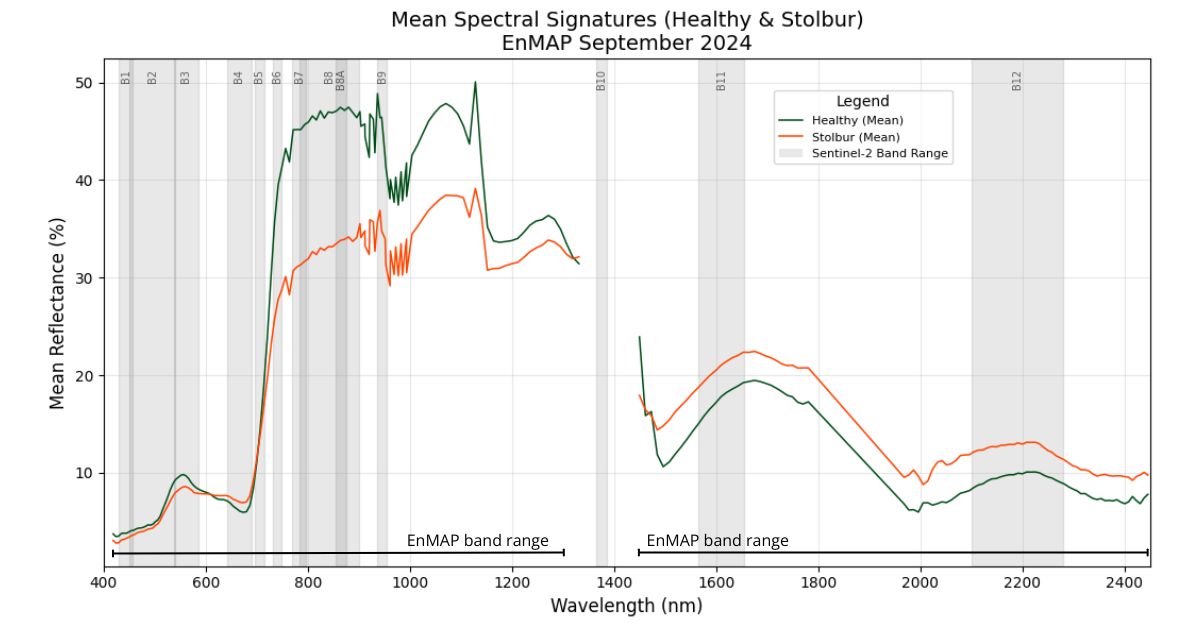
In 2022, the Deutsche Raumfahrtagentur launched the hyperspectral satellite EnMAP. Rather than capturing individual sections of the electromagnetic spectrum, it covers almost the entire wavelength range from UV radiation to infrared radiation (see Figure: Coverage of the Sentinel-2 multispectral satellite in gray).
We wanted to find out: What additional insights do we gain with this technological advance?
For the Deutsche Raumfahrtagentur, we researched how EnMAP data can help us detect sugar beet diseases. Can the data distinguish between infested and healthy fields? Can we use it to distinguish between Stolbur, Cercospora, and SBR diseases?
We investigated the spectral signatures of healthy and diseased sugar beets to determine the most powerful index for disease detection (see Figure).
The disadvantage of the hyperspectral satellite is that it captures only about one image of the same field per month. In the next step, we therefore combined the high spectral resolution of EnMAP with the high temporal and spatial resolution of Sentinel-2. Our model allows us to make optimal use of the advantages of both satellites.
Thank you to Bundesministerium für Wirtschaft und Klimaschutz for making this project possible with financial support.